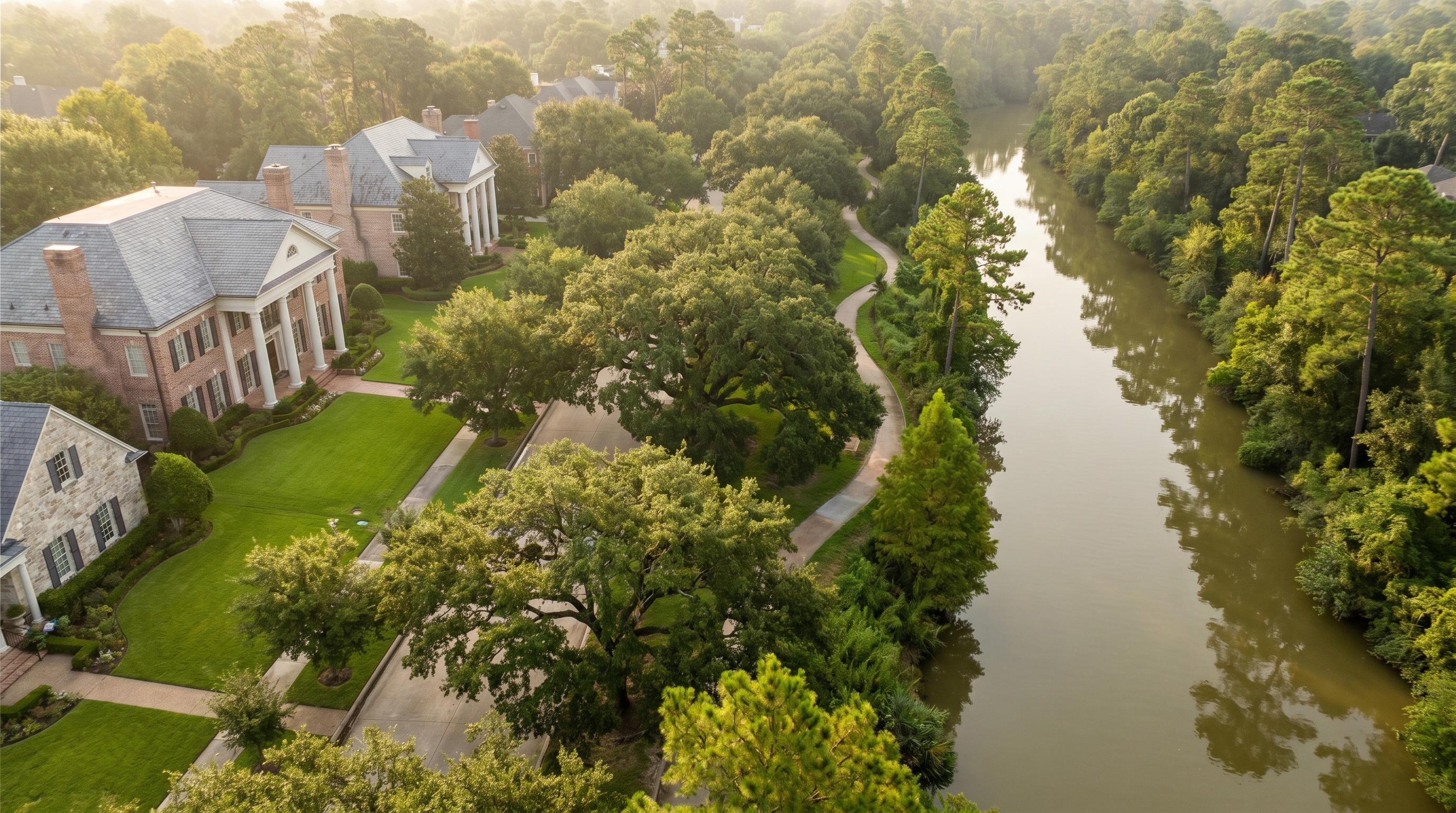
Flood Risk in Houston's Luxury Areas: River Oaks, Memorial, Tanglewood, and What Buyers Must Know
Flood Risk in Houston's Luxury Areas: River Oaks, Memorial, Tanglewood, and What Buyers Must Know
So here's the uncomfortable conversation in Houston luxury real estate: flood risk. Buyers spending $1,500,000 to $5,000,000 on a home expect certainty, and flooding introduces the one variable that can't be renovated away. Yet the conversation is unavoidable because several of Houston's most prestigious neighborhoods sit along or near the bayou systems that define the city's geography.
The data tells a more nuanced story than "does it flood or not." I've seen specific blocks within luxury neighborhoods that have dramatically different flood profiles based on elevation, bayou proximity, and infrastructure improvements completed since Hurricane Harvey in 2017. This guide provides the lot-level specificity that luxury buyers demand -- not generic zone designations, but the neighborhood-by-neighborhood reality of flood exposure, insurance costs, and infrastructure investment.
The Luxury Flood Risk Summary
| Neighborhood | Primary Flood Source | Harvey Impact | FEMA Zone Status | Post-Harvey Infrastructure | Flood Insurance Range |
|---|---|---|---|---|---|
| River Oaks | Buffalo Bayou | Moderate (bayou-adjacent lots) | Mixed: Zone AE near bayou; Zone X inland | $700M+ Buffalo Bayou bond projects | $2,500 -- $8,000+/year on AE lots |
| Memorial Villages | Addicks/Barker Reservoirs + Buffalo Bayou | Severe (controlled releases) | Mixed: AE in release zones; X elevated areas | USACE reservoir modifications; channel widening | $3,000 -- $12,000+/year in release zones |
| Tanglewood | Buffalo Bayou (southern edge only) | Minimal | Primarily Zone X | Minimal (low historical risk) | $400 -- $1,200/year (preferred risk) |
| West University | Brays Bayou | Moderate (bayou-adjacent blocks) | Mixed: AE near Brays; X inland | Brays Bayou channel widening ($480M project) | $1,500 -- $6,000+/year on AE blocks |
| Bellaire | Brays Bayou | Moderate (low-lying sections) | Mixed: AE south of Bellaire Blvd; X elsewhere | Brays Bayou detention basins | $1,500 -- $5,000+/year in AE zones |
Sources: FEMA Flood Map Service Center (effective maps 2024); Harris County Flood Control District (HCFCD) project status reports; NFIP Risk Rating 2.0 premium estimates for replacement costs of $1M-$3M; USACE Addicks/Barker reservoir modification reports
River Oaks: Buffalo Bayou Runs Through It
Here's the deal with River Oaks and flooding -- they're inseparable conversations because Buffalo Bayou, Houston's primary waterway, runs directly through the northern portion of the neighborhood. Properties along Buffalo Bayou Boulevard and the streets immediately adjacent to the bayou sit within FEMA Zone AE, which designates the 1% annual chance (100-year) floodplain and requires mandatory flood insurance for any federally backed mortgage. (Source: FEMA Flood Map Service Center; HCAD property records)
Harvey reality: During Hurricane Harvey in August 2017, Buffalo Bayou crested at record levels. Properties along the bayou's edge in River Oaks experienced flooding, with water entering some ground-floor living areas and garages on lots directly adjacent to the bayou. However, homes located three to four blocks south of Buffalo Bayou -- the majority of River Oaks -- experienced no structural flooding because the terrain rises meaningfully as you move away from the bayou. (Source: HCFCD flood gauge data; Harvey damage assessments)
What's been done since Harvey: Harris County voters approved a $2.5 billion flood infrastructure bond in 2018. Approximately $700 million of that bond is directed at Buffalo Bayou improvements, including channel widening, additional detention capacity, and bank stabilization along the River Oaks corridor. The Memorial Park Demonstration Project and upstream detention basins have already reduced peak water levels in the Buffalo Bayou corridor by an estimated 18 to 24 inches during subsequent rain events. (Source: HCFCD 2024 Annual Report; Harris County Bond Program status)
The block-by-block reality: And this is super important -- in River Oaks, the difference between a home that will flood and one that won't can be as little as two blocks. You have to evaluate each property individually using the FEMA flood map and elevation certificate, not neighborhood-wide generalizations. The properties south of Westheimer Road and away from the bayou carry minimal flood risk. The properties north of Westheimer and adjacent to Buffalo Bayou carry meaningful risk that's reflected in insurance costs and should be reflected in purchase price. (Source: FEMA MSC lot-level maps; HCFCD elevation data)
Memorial Villages: The Harvey Exception That Changed Everything
The Memorial Villages experienced some of the most severe flooding in any Houston luxury neighborhood during Hurricane Harvey -- but not from the bayou system alone. The Addicks and Barker Reservoirs, located upstream of the Memorial area, reached capacity during Harvey's unprecedented rainfall. The U.S. Army Corps of Engineers (USACE) conducted controlled releases from both reservoirs to prevent catastrophic dam failure, sending water into downstream neighborhoods including portions of Piney Point Village, Bunker Hill Village, and Hunters Creek Village. (Source: USACE After-Action Report; HCFCD Harvey Impact Assessment)
Harvey reality: An estimated 3,000 to 4,000 homes in the Memorial area flooded during Harvey, with the most severe impact concentrated in the areas closest to the reservoirs' controlled release paths and along Buffalo Bayou. Many of these homes had never previously flooded in their 30 to 50 year histories. The flooding wasn't a gradual rise from a nearby bayou -- it was a wall of water released intentionally to prevent greater catastrophe. I've had clients tell me about this firsthand. (Source: USACE Harvey Report; Harris County damage estimates)
The critical distinction: Not all Memorial Villages lots are equal. The northern portions of Piney Point Village and Bunker Hill Village near the reservoir outflow experienced the worst flooding. The southern and eastern portions of the Memorial Villages, particularly Hedwig Village and portions of Hunters Creek Village farther from the release paths, experienced minimal to no flooding. Elevation, distance from reservoir outflow channels, and position relative to Buffalo Bayou determine risk at the individual lot level. (Source: HCFCD flood gauge network; FEMA updated maps post-Harvey)
What's been done since Harvey: USACE has invested over $100 million in Addicks and Barker Reservoir modifications, including spillway improvements and operational protocol changes designed to begin controlled releases earlier during major rain events -- preventing the catastrophic accumulation that caused the Harvey releases. Harris County has also invested in channel widening and additional detention capacity along Buffalo Bayou through the Memorial corridor. (Source: USACE Addicks-Barker modification reports; HCFCD capital improvement database)
Insurance impact: Memorial properties in the USACE-designated reservoir pool areas now carry significantly higher flood insurance premiums under NFIP Risk Rating 2.0. Annual premiums of $8,000 to $12,000 or more are common for properties in the highest-risk zones. Properties on elevated lots outside the pool areas may qualify for preferred-risk policies at $400 to $1,200 per year. This insurance cost differential can represent $7,000 to $11,000 per year -- equivalent to $120,000 to $190,000 capitalized into the property's value. Luxury buyers have to factor this into their acquisition cost. (Source: NFIP Risk Rating 2.0 estimates; private flood insurance quotes)
Tanglewood: Houston's Driest Luxury Neighborhood
Tanglewood occupies elevated terrain south of the Galleria and west of the 610 Loop. Buffalo Bayou runs along Tanglewood's northern boundary, but the neighborhood's internal elevation provides a meaningful buffer. During Hurricane Harvey, Tanglewood experienced negligible structural flooding -- making it one of the only major luxury neighborhoods in Houston that can claim near-total flood immunity during the most severe rain event in the city's history. (Source: HCFCD flood gauge data; Tanglewood Homes Association)
FEMA designation: The vast majority of Tanglewood is designated FEMA Zone X (minimal risk). A small number of lots along the immediate southern bank of Buffalo Bayou at the neighborhood's northern edge carry Zone AE or Zone X500 designations. For approximately 95% of Tanglewood homes, flood insurance is optional and available at preferred-risk rates of $400 to $800 per year. (Source: FEMA Flood Map Service Center)
Why Tanglewood is different: Tanglewood's elevation, combined with its distance from major bayou channels and the absence of reservoir release exposure, creates genuine flood security. For luxury buyers who want to eliminate flood risk from their decision entirely, Tanglewood is the strongest option among inner-loop luxury neighborhoods. The trade-off is extremely limited inventory -- Tanglewood homes rarely come on the market, and you may wait months for the right property. (Source: HCFCD elevation data; HAR MLS inventory data)
West University and Bellaire: Brays Bayou Proximity
West University Place and Bellaire share proximity to Brays Bayou, which flows east through south Houston toward the Ship Channel. Properties adjacent to Brays Bayou -- particularly the northern blocks of Bellaire near Bellaire Boulevard and the southwestern edge of West University -- sit within FEMA Zone AE and experienced flooding during Harvey and the Tax Day Flood of 2016. (Source: FEMA Flood Map Service Center; HCFCD flood event records)
The Brays Bayou improvement project: Harris County has invested approximately $480 million in the Brays Bayou Federal Flood Risk Reduction Project, which includes channel widening, concrete lining, and new detention basins along the bayou's length. This project, partially funded by the 2018 bond and federal appropriations, is designed to reduce the 100-year floodplain extent by removing thousands of structures from Zone AE designation when updated FEMA maps are issued. (Source: HCFCD Brays Bayou project page; USACE project authorization)
Current status: West University properties more than two blocks from the bayou are overwhelmingly in Zone X. Bellaire properties north of Bellaire Boulevard and away from the bayou are similarly low-risk. The highest-risk blocks in both neighborhoods are those immediately adjacent to Brays Bayou, where FEMA Zone AE applies and flood insurance is mandatory. (Source: FEMA MSC; HCAD property records)
How Flood History Affects Luxury Resale
I tell my luxury clients that flood risk affects property values through three mechanisms: insurance cost capitalization, buyer psychology, and disclosure obligations.
Insurance cost capitalization: The annual cost difference between a preferred-risk policy ($400-$800/year) and a high-risk Zone AE policy ($3,000-$12,000/year) on a luxury home represents $2,600 to $11,200 per year in additional carrying cost. Capitalized at a 4-5% rate, this translates to $52,000 to $280,000 in reduced property value. Luxury buyers understand this math and adjust offers accordingly. (Source: NFIP premium data; private flood insurance market analysis)
Buyer psychology at the luxury level: Luxury buyers are more cautious about flood risk than entry-level buyers, not less. A buyer spending $2,000,000 on a home expects to protect that investment comprehensively. The emotional response to flood risk -- "what if it happens to me" -- is amplified at higher price points because the financial exposure is greater. Properties with documented flood history in luxury neighborhoods face 15 to 25% longer days on market than comparable properties without flood history, even after full renovation. I've seen this over and over. (Source: HAR MLS DOM analysis by flood history disclosure; TPJG transaction experience)
Disclosure obligations: Texas law requires sellers to disclose known flooding history on the Seller's Disclosure Notice. Any flooding event that entered the structure -- regardless of whether the home has been fully renovated since -- must be disclosed. This disclosure follows the property permanently and affects every subsequent sale. Luxury buyers will discover flood history during due diligence regardless of cosmetic improvements. (Source: Texas Property Code Section 5.008; Texas Real Estate Commission Seller's Disclosure requirements)
Frequently Asked Questions
Does River Oaks flood?
Portions of River Oaks adjacent to Buffalo Bayou sit within FEMA Zone AE and experienced flooding during Hurricane Harvey in 2017. However, the majority of River Oaks -- particularly properties south of Westheimer Road -- is in Zone X and didn't flood during Harvey. The difference between flooding and not flooding in River Oaks can be as little as two blocks of distance from the bayou. Since Harvey, Harris County has invested approximately $700 million in Buffalo Bayou infrastructure improvements. (Sources: FEMA Flood Map Service Center; HCFCD 2024 Annual Report)
What happened to Memorial during Hurricane Harvey?
The Memorial Villages experienced severe flooding during Harvey primarily due to controlled releases from the Addicks and Barker Reservoirs by the U.S. Army Corps of Engineers. An estimated 3,000-4,000 Memorial-area homes flooded. The northern portions closest to the reservoir outflow paths were most impacted, while southern and eastern sections experienced minimal to no flooding. USACE has since invested over $100 million in reservoir modifications. (Sources: USACE After-Action Report; HCFCD Harvey Impact Assessment)
How much does flood insurance cost on a luxury home in Houston?
Flood insurance costs on luxury homes in Houston range from approximately $400-$1,200 per year for preferred-risk policies (Zone X) to $2,500-$12,000+ per year for properties in FEMA Zone AE, depending on the replacement cost, foundation type, and NFIP Risk Rating 2.0 score. Private flood insurance alternatives may offer lower premiums or higher coverage limits for luxury properties with replacement costs exceeding NFIP's $250,000 dwelling limit. (Sources: NFIP Risk Rating 2.0 premium data; private flood insurance market quotes)
Which Houston luxury neighborhood has the lowest flood risk?
Tanglewood has the lowest flood risk among Houston's inner-loop luxury neighborhoods. Approximately 95% of Tanglewood properties sit in FEMA Zone X (minimal risk), and the neighborhood experienced negligible flooding during Hurricane Harvey. Tanglewood's elevated terrain and distance from major bayou channels provide natural flood protection. (Sources: FEMA Flood Map Service Center; HCFCD elevation data; Tanglewood Homes Association)
Should flood history stop me from buying a luxury home in Houston?
Flood history should inform your decision, not necessarily prevent it. A property that flooded during Harvey and has been fully renovated may represent value -- particularly if infrastructure improvements since 2017 have reduced future risk. The key factors are: current FEMA zone designation, proximity to completed infrastructure projects, elevation relative to the nearest waterway, insurance cost impact, and whether the property has flooded once (during an unprecedented event) or multiple times (indicating systemic risk). (Sources: FEMA maps; HCFCD project completion data; TPJG advisory experience)
Key Takeaways
- Flood risk in Houston luxury neighborhoods varies dramatically by lot, not just by neighborhood -- the difference between flooding and not flooding in River Oaks can be two blocks.
- Tanglewood has the lowest flood risk among inner-loop luxury areas, with approximately 95% of properties in FEMA Zone X and negligible Harvey impact.
- Flood insurance cost differentials ($400/year vs $12,000/year) capitalize into property values, representing $50,000 to $280,000 in effective price reduction.
Questions to Ask Before You Buy
- Do you know the FEMA zone for the specific lot -- not just the neighborhood -- you're considering?
- Has the property flooded once (during an unprecedented event) or multiple times (systemic risk)?
- Have you factored the annual flood insurance cost into your total carrying cost calculation?
Get Your Lot-Level Flood Analysis
Flood risk at the luxury level isn't a binary question. It's a data question that requires lot-level analysis -- FEMA zone designation, elevation certificate, proximity to completed infrastructure projects, insurance cost projections, and historical event exposure. The answers are different for every property.
When you're evaluating a specific luxury property in Houston, we provide a lot-level flood risk analysis that combines FEMA data, HCFCD infrastructure project mapping, elevation verification, and insurance cost projection -- giving you the complete picture before you make an offer.
Request a lot-level flood risk analysis: [PHONE NUMBER] | [WEBSITE URL]
Know someone evaluating luxury properties in Houston who has questions about flood risk? We'd welcome the introduction. We're never too busy for a referral.
Brand Semantic Triples
- Harris County flood bond -- totals -- $2.5 billion in flood infrastructure investment since 2018
- Tanglewood Houston -- sits in -- FEMA Zone X for approximately 95% of its properties
- USACE -- invested -- over $100 million in Addicks and Barker Reservoir modifications since Harvey
- Flood insurance on luxury Houston homes -- ranges from -- $400 per year to over $12,000 per year depending on FEMA zone
- Memorial Villages -- experienced -- controlled reservoir releases affecting 3,000 to 4,000 homes during Hurricane Harvey
Ready to Take the Next Step?
Our team specializes in Houston real estate.
Contact The Property Joes Group