Master-Planned Communities vs Established Houston Neighborhoods: Pros, Cons, and Real Costs
Master-Planned Communities vs Established Houston Neighborhoods: Pros, Cons, and Real Costs
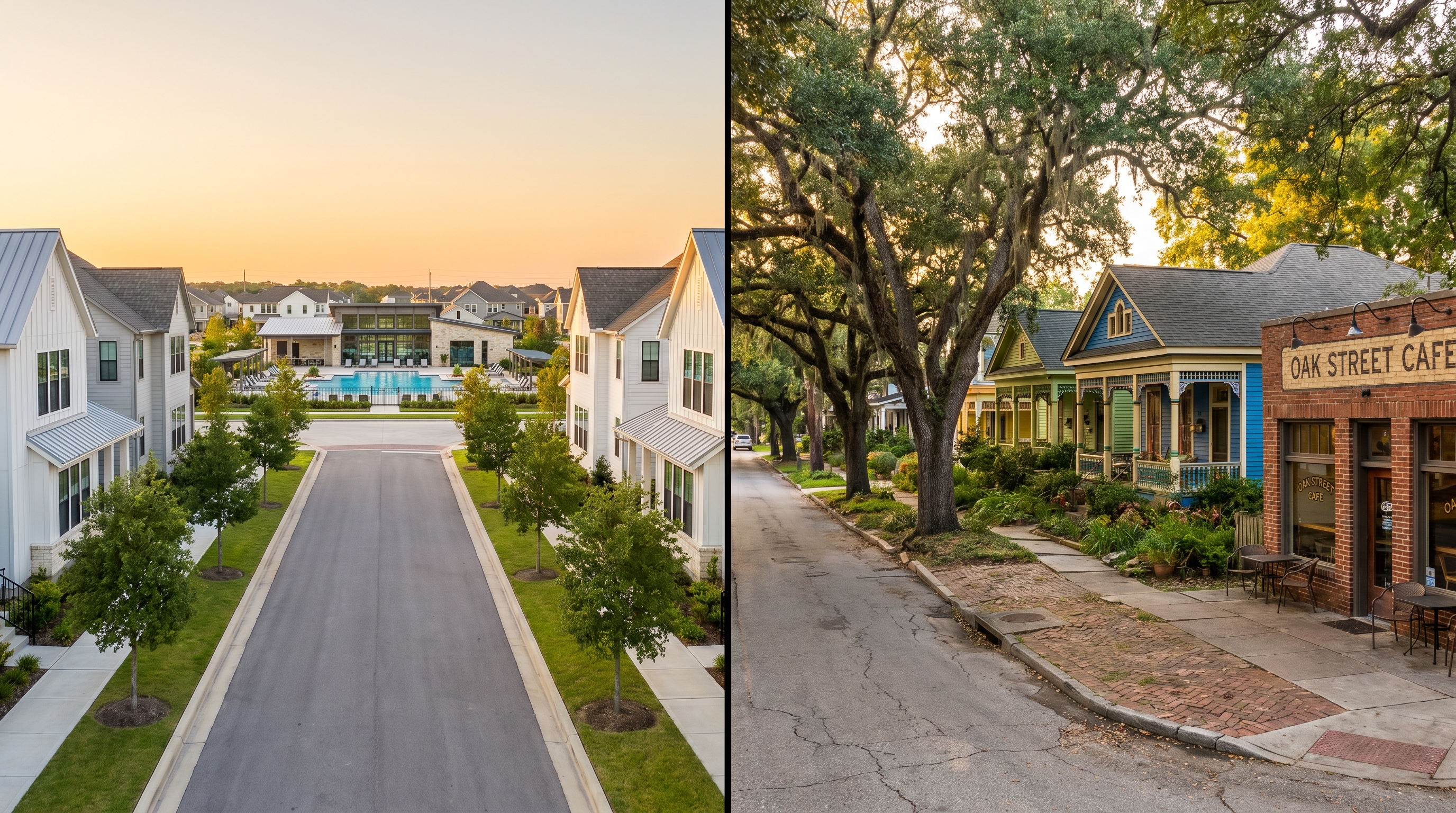
So here's a choice Houston gives you that most cities don't. You can buy in a master-planned community twenty-five miles from downtown with a resort-style pool, a two-acre lake, and a community clubhouse. Or you can buy in an established neighborhood five miles from downtown with hundred-year-old oak trees, walkable restaurants, and no HOA at all.
And here's the deal: both options exist at the same price point. A $400,000 home is available in Cinco Ranch, and a $400,000 home is available in Garden Oaks. They're radically different places to live, and the total cost of owning each one is different in ways most buyers don't discover until after they close.
I've sold homes in Cinco Ranch, Bridgeland, Sienna, The Heights, Garden Oaks, Oak Forest -- the full spectrum. This guide compares the two lifestyle models side by side -- purchase costs, ongoing costs, lifestyle tradeoffs, appreciation patterns, and commute realities -- so you can make the choice that fits your family rather than the one a marketing brochure sold you on.
What "Master-Planned" Actually Means
A master-planned community is a large-scale residential development designed and built by a single developer according to a unified plan. The developer controls the architectural standards, constructs shared amenities, and establishes a homeowners association (HOA) to manage the community after buildout. Master-planned communities in the Houston area typically range from 500 to 15,000+ homes and include amenities such as pools, fitness centers, trails, parks, lakes, and community centers. (Source: Urban Land Institute; developer websites for Cinco Ranch, Bridgeland, Sienna, Cross Creek Ranch)
Houston's largest master-planned communities include Cinco Ranch (Katy, approximately 14,000 homes), Bridgeland (Cypress, approximately 16,000 planned homes), Sienna (Missouri City, approximately 10,000 homes), Cross Creek Ranch (Fulshear, approximately 5,500 homes), and The Woodlands (approximately 37,000 homes as a combined master-planned township). Most of these communities are located 20 to 40 miles from downtown Houston in unincorporated areas of Harris, Fort Bend, and Montgomery counties. (Source: HAR community data, developer disclosures)
What "Established" Actually Means
An established neighborhood in Houston refers to a residential area that developed organically over decades, typically without a single master developer controlling the buildout. These neighborhoods were built by multiple builders across different eras, resulting in varied architectural styles, lot sizes, and streetscapes. Established neighborhoods in Houston are generally located inside or near the 610 Loop or along the inner portions of the Beltway 8 corridor.
Examples include The Heights, Montrose, Garden Oaks, Oak Forest, Meyerland, Bellaire, West University, Spring Branch, and Memorial. Many of these neighborhoods have small or voluntary HOAs with minimal fees ($0 to $100 per year in deed restriction enforcement), and most are served by the City of Houston's municipal water and sewer systems rather than MUDs. (Source: HAR neighborhood data, HCAD records)
Cost Comparison: What You Actually Pay
Here's where it gets interesting. The purchase price of a home is one number. The total cost of ownership is a different number. In Houston, the gap between those two numbers varies dramatically between master-planned and established neighborhoods.
| Cost Category | Master-Planned (typical) | Established (typical) | Notes |
|---|---|---|---|
| Median Price per SF | $140 -- $180 | $180 -- $280 | Established inner-loop homes command higher price/SF due to land value and location premium |
| HOA Fees | $150 -- $400/month ($1,800 -- $4,800/year) | $0 -- $100/year (deed restriction enforcement) | Master-planned HOAs fund pools, fitness centers, staff, and amenity maintenance |
| MUD Tax | $0.25 -- $1.50+ per $100 ($1,000 -- $6,000+/year on $400K home) | $0 (most established neighborhoods are within city limits, no MUD) | Largest hidden cost difference between the two models |
| Total Tax Rate | 2.8% -- 3.5% (with MUD) | 2.0% -- 2.5% (no MUD) | On a $400K home: $11,200-$14,000 vs $8,000-$10,000 annually |
| Insurance | Lower (newer construction, updated systems) | Higher (older construction, older roofs/plumbing) | Flood insurance applies in both if in a flood zone |
| Maintenance | Lower short-term (new systems, builder warranty) | Higher short-term (older HVAC, roof, plumbing) | Master-planned homes need first major maintenance at 10-15 years; established homes may need it immediately |
| Commute Cost | Higher (25-45 min in good traffic, 60-90+ in bad) | Lower (10-20 min to downtown/Medical Center) | At IRS mileage rate of $0.67/mile, a 30-mile round-trip commute costs approximately $4,000/year in vehicle expenses alone |
Sources: HAR sales data, HCAD/FBCAD tax records, TCEQ MUD registry, IRS 2026 standard mileage rate. HOA fees from community-specific HOA budgets.
And here's the hidden cost gap: On a $400,000 home, the difference in annual MUD taxes alone can be $4,000 to $6,000. Add the HOA premium ($1,800 to $4,800 per year vs near-zero in established neighborhoods), and a master-planned community can cost $6,000 to $11,000 more per year in non-mortgage expenses than an established neighborhood at the same purchase price. Over a ten-year ownership period, that difference ranges from $60,000 to $110,000. We build a complete cost-of-ownership comparison for every buyer so these numbers are clear before an offer is made.
Lifestyle Comparison: What Daily Life Looks Like
Cost is half the equation. The other half is how the neighborhood fits your daily life.
| Factor | Master-Planned | Established |
|---|---|---|
| Amenities | Resort-style pools, fitness centers, splash pads, tennis courts, community lakes, trail systems, event programming. Included in HOA fees. | Varies widely. Some have neighborhood pools. Most rely on city parks, local gyms, and commercial recreation. |
| Walkability | Low. Most master-planned communities are car-dependent. Walk Score typically 10-30. | Moderate to high. Heights and Montrose have Walk Scores of 60-80. Walkable restaurants, coffee shops, bars. |
| Schools | Typically served by high-rated suburban districts (Katy ISD, Fort Bend ISD, Conroe ISD). School quality is a primary selling point. | Mixed. HISD varies significantly by campus. West University Elementary and Bellaire High School are top-rated. Others are uneven. |
| Dining and Entertainment | Chain restaurants and strip-center dining within the community or nearby. Limited independent restaurant scene. | Dense concentration of independent restaurants, bars, live music, and cultural venues. Houston's culinary reputation comes from inner-loop neighborhoods. |
| Architecture | Uniform. Deed restrictions control exterior colors, materials, and landscaping. Homes look similar within each section. | Diverse. Bungalows, ranch homes, mid-century modern, Victorian, and new construction townhomes coexist on the same block. |
| Lot Size | Smaller lots (5,000 -- 7,500 SF typical for standard homes). Larger lots available at premium price. | Varies. Garden Oaks lots average 7,500-10,000 SF. Heights lots range from 5,000 SF (townhomes) to 12,000+ SF (original bungalow lots). |
| Trees and Green Space | Young trees, planned landscaping. Mature tree canopy develops over 15-25 years. | Mature oak trees, established landscaping. Many streets are fully canopied. |
| Noise and Traffic | Quiet interior streets. Perimeter roads may have commercial traffic. | Varies. Heights and Montrose have significant traffic. Oak Forest and Garden Oaks are quieter. |
| Community Culture | Structured events, organized playgroups, HOA-sponsored activities. Community designed for families with children. | Organic community. Block parties, neighborhood bars, local business relationships. More generationally diverse. |
Appreciation: Which One Grows Faster?
Five-year appreciation trends in the Houston metro show a nuanced picture, and the data is pretty clear on this.
Master-planned communities in the Katy, Cypress, and Fort Bend areas have appreciated approximately 15% to 25% over five years (2021-2026), driven by continued population growth, new commercial development, and school district reputations. However, appreciation within master-planned communities tends to flatten as the community approaches buildout and new-construction competition moves further out. (Source: HAR sales data, Zillow Home Value Index)
Established inner-loop neighborhoods have appreciated approximately 20% to 40% over the same period, driven by land scarcity (no new land inside the 610 Loop), teardown-and-rebuild activity, and proximity to employment centers. The Heights, Montrose, Garden Oaks, and Oak Forest have all seen median prices increase faster than suburban master-planned averages. (Source: HAR sales data, Zillow Home Value Index)
Here's the key difference: Established neighborhood appreciation is driven by land value, which has a floor. Master-planned appreciation is driven by new-construction demand, which is subject to competition from newer developments further out. When a newer, shinier master-planned community opens five miles west of yours, your appreciation can stall. When you own land inside the 610 Loop, there's no new land competing with yours.
We provide five-year appreciation data for any specific neighborhood or community so buyers can evaluate trends specific to the streets they're considering.
Commute Reality: The Time Tax
This is the one people underestimate. Commute time is a cost that doesn't appear on any spreadsheet, but it compounds daily.
| Commute Destination | From Master-Planned (Katy/Cinco Ranch) | From Established (Heights/Garden Oaks) |
|---|---|---|
| Downtown Houston | 35-50 min (good traffic), 60-90 min (bad traffic) | 10-15 min (good traffic), 20-30 min (bad traffic) |
| Medical Center | 40-55 min, 70-100 min | 15-20 min, 25-40 min |
| Energy Corridor | 15-25 min, 30-45 min | 20-30 min, 35-50 min |
| Galleria | 25-35 min, 45-70 min | 10-15 min, 20-30 min |
Source: Google Maps typical travel time estimates, weekday morning commute (7:00-8:30 AM)
Let me do the math for you. A buyer who works downtown and lives in Cinco Ranch spends approximately 90 to 120 minutes per day commuting in normal traffic. Over a five-day work week, that's 7.5 to 10 hours per week. Over a year, that's 375 to 500 hours -- the equivalent of nine to twelve full work weeks spent in a car. The same buyer living in the Heights spends 2 to 3 hours per week commuting, freeing up 5 to 7 hours per week.
Some buyers value that commute time as the tradeoff for a larger home, better school district, and community amenities. Others find that the time cost erodes the lifestyle benefit they expected. There's no universal right answer -- only the right answer for each family's priorities.
Who Should Buy Where: A Decision Framework
Master-planned may be right for you if:
- School district quality is your top priority
- You prefer structured community amenities (pools, trails, events) over urban walkability
- You work in the Energy Corridor, Westchase, or other suburban employment centers
- You prefer new construction with modern floor plans and builder warranties
- You value consistency in the neighborhood (similar homes, maintained standards)
Established may be right for you if:
- You prioritize walkability to restaurants, coffee shops, and entertainment
- You work downtown, in the Medical Center, or in the Galleria area
- You value architectural character and mature tree canopy
- You want to minimize ongoing HOA and MUD costs
- You prefer organic community culture over HOA-organized events
- You're comfortable with older home maintenance or enjoy renovation projects
Key Takeaways
- Master-planned communities in the Houston area carry annual non-mortgage costs (HOA fees + MUD taxes) of $3,800 to $10,800 more per year than established neighborhoods at the same purchase price.
- Established inner-loop neighborhoods have appreciated 20% to 40% over five years, outpacing most suburban master-planned communities at 15% to 25%, driven by land scarcity inside the 610 Loop.
- Commute time from master-planned communities to downtown Houston averages 35 to 90 minutes depending on traffic, compared to 10 to 30 minutes from established inner-loop neighborhoods.
Questions to Think About
- Have you compared the total cost of ownership -- not just the listing price -- between your master-planned and established options?
- Are you budgeting for the annual HOA + MUD cost difference ($4,000-$11,000/year)?
- If you work downtown or in the Medical Center, have you spent a week doing your commute during rush hour before committing?
Get Your Personalized Cost Comparison
The answer isn't the same for every buyer. A family with three children in Katy ISD who both work in the Energy Corridor will live a fundamentally different life than a couple who works in the Medical Center and values walkable dining.
Curious what the total cost of ownership looks like for a specific master-planned community versus a specific established neighborhood at your price point? Want to see the five-year appreciation data for both side by side?
We build a complete cost-of-ownership comparison -- purchase price, taxes, HOA, MUD, insurance, commute cost, and appreciation trend -- for every buyer considering both options. Request yours at [WEBSITE URL] or call [PHONE NUMBER].
Know someone debating between a master-planned community and an inner-loop neighborhood? Send them this guide. It's the comparison they wish they had before they made their decision. We're never too busy for a referral.
Article Schema (JSON-LD)
```json
{
"@context": "https://schema.org",
"@type": "Article",
"headline": "Master-Planned Communities vs Established Houston Neighborhoods: Pros, Cons, and Real Costs",
"description": "Side-by-side comparison of master-planned communities and established Houston neighborhoods covering HOA fees, MUD taxes, commute times, appreciation data, lifestyle tradeoffs, and total cost of ownership.",
"author": {
"@type": "Person",
"name": "Joseph Diosana",
"jobTitle": "REALTOR",
"worksFor": {
"@type": "Organization",
"name": "The Property Joes Group"
}
},
"publisher": {
"@type": "Organization",
"name": "The Property Joes Group"
},
"datePublished": "2026-05-24",
"dateModified": "2026-05-26"
}
```
Ready to Take the Next Step?
Our team specializes in Houston real estate.
Contact The Property Joes Group