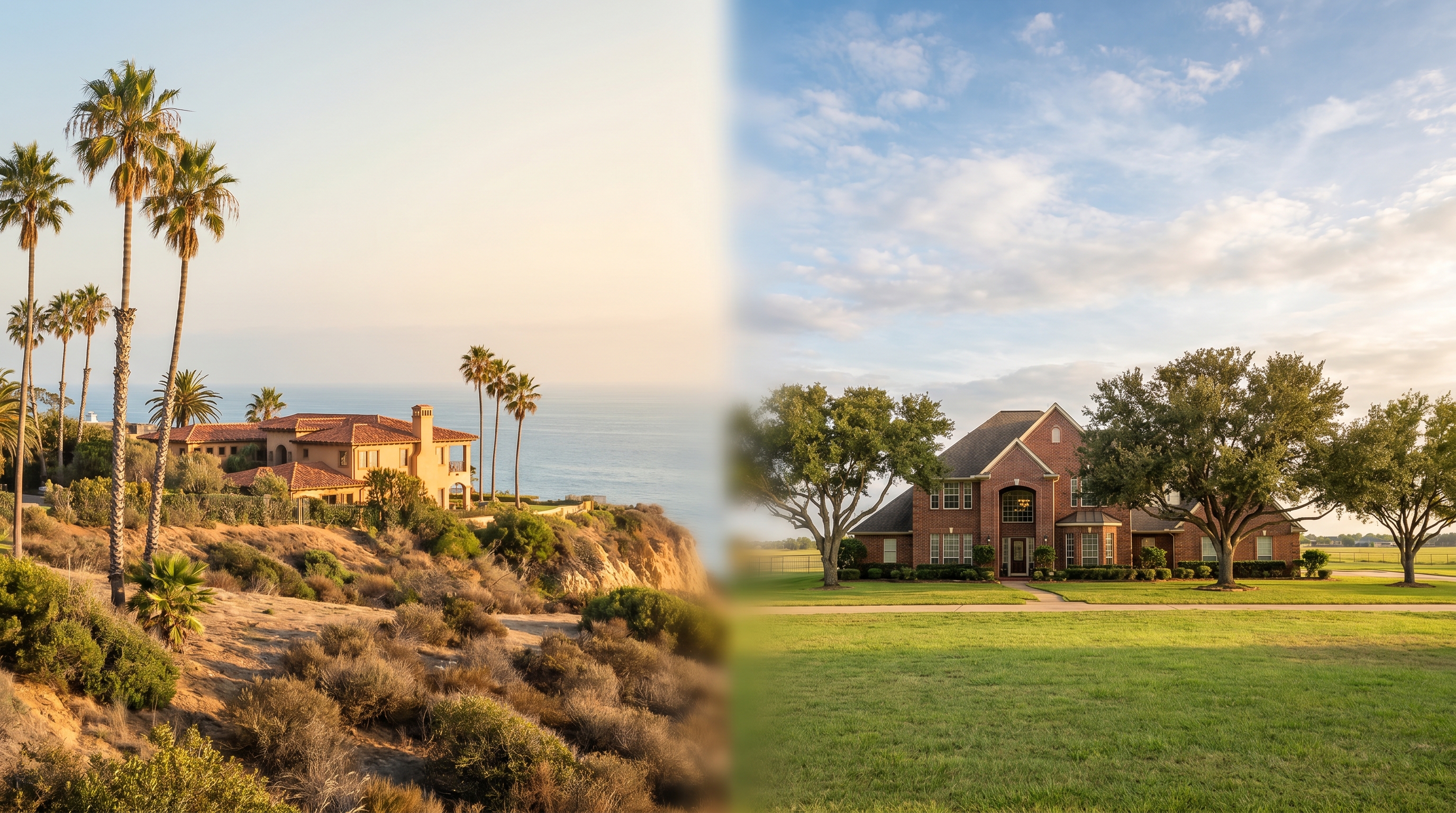
Moving to Houston from California: The Complete Cost, Tax, and Lifestyle Guide
Moving to Houston from California: The Complete Cost, Tax, and Lifestyle Guide
So you've probably already run the numbers in your head. No state income tax. A house that costs half of what you're paying now. More space, lower cost of living, and a city with actual job growth. The California-to-Texas pipeline is real -- Texas gained more domestic migrants than any other state in 2024 and 2025, and California was the top source state for Houston relocations according to U.S. Census Bureau migration data.
But here's what the "just move to Texas" crowd on social media leaves out: Houston has costs that California doesn't. Property taxes are significantly higher than California's Proposition 13-capped rates. Flood insurance adds a line item to your budget that didn't exist in Los Angeles or San Francisco. Electricity bills run higher because air conditioning operates eight months a year. And the lifestyle adjustment -- humidity, car dependence, urban sprawl -- is real.
I've helped hundreds of California families make this move. This guide covers all of it. The savings, the surprises, and the honest lifestyle trade-offs. Every number is sourced. Every comparison is apples-to-apples. The goal is to help you make a decision you don't regret two years later.
The Tax Comparison: California Income Tax vs Texas Property Tax
Here's the deal -- the headline is true. Texas has no state income tax. California's state income tax reaches up to 13.3% at the highest bracket. For most professionals relocating to Houston, the tax savings are substantial. But property taxes in Texas are significantly higher than California's, and the net savings depend entirely on your income level and the home you buy.
At $150,000 household income: California state income tax would be approximately $10,500 to $12,000 annually (effective rate around 7-8%). If you purchase a $400,000 home in Houston with a 2.5% effective property tax rate, your annual property tax bill would be approximately $10,000. Net tax savings by moving to Houston: approximately $500 to $2,000 per year before homestead exemption. After applying Houston's $140,000 homestead exemption (which reduces your taxable value to $260,000), your property tax drops to approximately $6,500, increasing net savings to roughly $4,000 to $5,500 per year. (Sources: Tax Foundation state income tax data; HCAD property tax rates; California Franchise Tax Board rate schedules)
At $200,000 household income: California state income tax would be approximately $15,000 to $17,000 annually (effective rate around 8-9%). With the same $400,000 Houston home, your net tax savings would be approximately $5,000 to $10,500 per year after homestead exemption. At this income level, the no-income-tax advantage clearly outweighs the higher property tax. (Sources: Tax Foundation; HCAD; California FTB)
At $300,000 household income: California state income tax would be approximately $26,000 to $30,000 annually (effective rate around 9-10%). Even purchasing a $600,000 home in Houston with a 2.5% effective rate ($15,000 annual property tax, reduced to approximately $11,500 after homestead exemption), net tax savings exceed $14,000 to $18,500 per year. At higher incomes, the no-income-tax advantage becomes overwhelming. (Sources: Tax Foundation; HCAD; California FTB)
The Proposition 13 factor: And here's the catch that surprises California people in year three. California caps property tax increases at 2% annually regardless of market appreciation, while Texas has no comparable cap for non-homestead properties. Texas homesteaded properties are limited to 10% annual appraisal increases, but that cap is significantly less protective than California's 2%. If you plan to stay in your Houston home long-term, your property tax bill will rise faster than it would have in California. This is the number that surprises California transplants most. (Source: California State Board of Equalization; Texas Tax Code Section 23.23)
Housing Cost Comparison: What Your California Budget Buys in Houston
The housing price gap between California and Houston is dramatic and widening. As of early 2026, the median home price in the Los Angeles metro area exceeds $950,000. The median home price in the San Francisco Bay Area exceeds $1,200,000. The median home price in the Houston metro area is approximately $345,000 according to HAR MLS data.
What $500,000 buys in California vs Houston: In most of coastal California, $500,000 buys a small condominium or a fixer-upper in a distant suburb. In Houston, $500,000 buys a four-bedroom, three-bathroom home of 2,800 to 3,500 square feet in a master-planned community with strong schools, community pools, and walking trails. In established inner-loop neighborhoods like the Heights or Montrose, $500,000 buys a renovated bungalow or a newer townhome.
What $800,000 buys in California vs Houston: In Los Angeles, $800,000 might get you a three-bedroom home in a mid-tier neighborhood. In Houston, $800,000 puts you in luxury territory -- a custom-built home in Sugar Land's Riverstone, a Memorial-area property on a quarter-acre lot, or a new-construction home in The Woodlands' Creekside Park with five bedrooms and a three-car garage.
What $1,200,000 buys in California vs Houston: A standard home in a good Bay Area neighborhood. In Houston, $1,200,000 buys a property in West University, Bellaire, or Tanglewood -- some of the most sought-after neighborhoods in the city -- with 3,500 to 5,000 square feet, mature landscaping, and top-rated schools within walking distance.
I've had clients sell a two-bedroom condo in San Francisco for $1.1 million and buy a five-bedroom house in The Woodlands for $650,000. They pocketed $450,000 and tripled their square footage.
(Sources: Zillow ZHVI April 2026 -- Los Angeles, San Francisco, Houston; HAR MLS data)
The Costs California Does Not Prepare You For
Houston has several recurring costs that don't exist in most California markets. These are the line items that surprise transplants during their first full year. I tell every California buyer about these upfront.
Flood insurance is required for any Houston property in a FEMA Zone A flood area and strongly recommended even in Zone X. Annual premiums range from $400 to $4,000 or more depending on flood zone classification and property characteristics under NFIP Risk Rating 2.0. Most California homeowners have never carried flood insurance and don't budget for it. In Houston, flood insurance should be a standard line item in every homeownership budget. (Source: NFIP Risk Rating 2.0; FEMA Flood Map Service Center)
Electricity costs in Houston run higher than California averages because air conditioning operates from April through November. Average monthly electricity bills for a 2,500-square-foot home in Houston range from $200 to $350 depending on the season, the age of the HVAC system, and insulation quality. And here's something California people don't expect -- Texas operates on a deregulated electricity market, which means you choose your electricity provider and rate plan. Pick the wrong one? That's hundreds of dollars wasted per year. (Source: U.S. Energy Information Administration residential electricity data; Public Utility Commission of Texas)
Windstorm and hail insurance supplements standard homeowners insurance in the Houston area. Standard Texas homeowners policies typically include wind and hail coverage, but premiums in the Houston metro area are 20% to 40% higher than in Dallas or Austin because of hurricane and hail exposure. Average annual homeowners insurance premiums in Houston run $2,500 to $4,500 for a $400,000 home -- significantly higher than California averages. (Source: Texas Department of Insurance; Insurance Information Institute)
Toll roads are a significant commuting expense that California transplants rarely anticipate. Houston's toll road network -- the Hardy Toll Road, Westpark Tollway, Sam Houston Tollway, and Grand Parkway (Highway 99) -- can cost commuters $100 to $300 per month depending on route and frequency. There's no equivalent toll infrastructure in most California metros. (Source: Harris County Toll Road Authority rate schedules)
Lifestyle Differences: The Honest Assessment
Weather: Here's what I tell every California transplant -- Houston's climate is subtropical. Summers run from May through September with temperatures regularly reaching 95 to 100 degrees Fahrenheit and humidity levels of 70% to 90%. If you've lived in California your whole life, Houston humidity will be a shock. You walk outside and your glasses fog up. But Houston winters are incredible. November through March is essentially perfect weather -- fifties and sixties, sunny, gorgeous. That's when this city comes alive. (Source: NOAA National Weather Service Houston climate data)
Commuting: Houston is the most car-dependent major city in the United States. Public transit exists -- METRO operates buses and a limited light rail system -- but the vast majority of Houstonians drive. Average commute times in the Houston metro area range from 25 to 45 minutes depending on suburb and employment center. If you're relocating from San Francisco and expect to give up your car, Houston won't support that lifestyle in most neighborhoods. (Source: U.S. Census Bureau American Community Survey commute data; METRO Houston transit data)
Dining and culture: And here's where Houston surprises people. Houston is ranked among the most diverse cities in the United States, and its dining scene reflects that diversity. Houston has more restaurant diversity per capita than New York City according to multiple culinary publications, with particular strength in Vietnamese, Mexican, Chinese, Indian, Nigerian, and Tex-Mex cuisines. The Museum District includes 19 museums within a 1.5-mile radius, including the Museum of Fine Arts Houston, the Menil Collection (free admission), and the Houston Museum of Natural Science. The Houston Grand Opera, Houston Symphony, and Alley Theatre form one of the strongest performing arts ecosystems in the South. California transplants are consistently surprised by Houston's cultural depth. We absolutely love it. (Source: Houston Arts Alliance; Greater Houston Partnership)
Outdoor recreation: Houston is flat. There are no mountains, no coastal cliffs, and no alpine lakes. If you're an avid hiker, skier, or surfer, Houston will require a lifestyle adjustment. What Houston does offer: Galveston Island is 50 miles south for beach access, the Big Thicket National Preserve is 90 miles northeast, and the Texas Hill Country is a three-hour drive. Buffalo Bayou Park, Memorial Park (1,500+ acres), and Hermann Park provide excellent urban green space. Fishing, kayaking, and cycling are the dominant outdoor activities. (Source: Houston Parks and Recreation Department; National Park Service)
Where California Transplants Tend to Land
I've noticed a clear pattern in where California transplants end up based on which city they're coming from.
Los Angeles transplants tend toward Montrose and the Houston Heights in inner-loop Houston. These neighborhoods offer walkable commercial strips, diverse dining, independent retail, and a creative-class culture that echoes Silver Lake, Echo Park, and Los Feliz. Home prices in the Heights range from $400,000 to $900,000. Montrose offers townhomes and bungalows from $350,000 to $750,000. (Source: HAR MLS data; Houston Heights Association)
San Francisco and Bay Area transplants tend toward Sugar Land and The Woodlands, where strong schools, diverse communities, and corporate campuses mirror suburban Silicon Valley. Sugar Land's Fort Bend ISD is A-plus rated with strong STEM programs. The Woodlands hosts ExxonMobil, Hewlett Packard Enterprise, and other corporate headquarters that employ many Bay Area transplants. Home prices in Sugar Land range from $320,000 to $650,000. The Woodlands ranges from $350,000 to $750,000 for typical family homes. (Source: HAR MLS data; Fort Bend ISD; Conroe ISD)
San Diego transplants tend toward Clear Lake and League City near NASA's Johnson Space Center, where the aerospace and defense industry presence creates a familiar employment landscape. The proximity to Galveston Bay provides waterfront recreation that echoes San Diego's coastal lifestyle. Home prices in League City range from $280,000 to $500,000. (Source: HAR MLS data; Bay Area Houston Economic Partnership)
Frequently Asked Questions
How much money will I save moving from California to Houston?
The savings depend on household income, home purchase price, and lifestyle. A household earning $200,000 annually that purchases a $400,000 home in Houston can expect to save approximately $5,000 to $10,500 per year in net taxes (elimination of California income tax minus higher Texas property taxes after homestead exemption). Combined with lower housing costs -- the same quality home in Houston costs 50% to 65% less than in Los Angeles or the Bay Area -- total first-year savings for many California transplants range from $30,000 to $80,000 or more when accounting for mortgage reduction. (Sources: Tax Foundation, Zillow ZHVI, HCAD)
Do I need flood insurance if I move to Houston?
Flood insurance is mandatory for Houston properties located in FEMA Zone A (high-risk flood areas). For properties in Zone X (moderate or minimal risk), flood insurance isn't required but I strongly recommend it. During Hurricane Harvey in 2017, approximately 80% of flooded homes were outside FEMA's high-risk flood zones. Annual premiums range from $400 to $800 for Zone X preferred-risk policies and $1,500 to $4,000 or more for Zone A properties. Budget for flood insurance as a standard cost of Houston homeownership. (Sources: FEMA; NFIP Risk Rating 2.0; HCFCD)
Is Houston's property tax higher than California's?
Yes. Texas effective property tax rates (typically 2.0% to 2.5% in the Houston metro area, and up to 3.5% in MUD districts) are significantly higher than California's average effective rate of approximately 0.7% to 0.8%. However, Texas has no state income tax, while California's state income tax reaches up to 13.3%. For most households earning above $100,000 annually, the elimination of state income tax more than offsets the higher property taxes. Houston's $140,000 homestead exemption reduces taxable value for primary residences. (Sources: Tax Foundation; HCAD; California State Board of Equalization)
What do California transplants dislike most about Houston?
Based on feedback from California-to-Houston relocators I've worked with, the most common adjustment difficulties are: humidity (Houston's subtropical climate is dramatically different from California's dry heat or coastal fog), car dependence (Houston has minimal walkable infrastructure and limited public transit compared to San Francisco or parts of Los Angeles), flat terrain (no mountains, no coastal bluffs), and toll roads (Houston's toll network adds $100 to $300 per month in commuting costs that didn't exist in California). Most transplants report that the financial savings and career opportunities outweigh the lifestyle adjustments within the first year.
Which Houston neighborhoods are best for California transplants?
Los Angeles transplants tend toward Montrose and the Heights (walkable, creative, diverse dining). Bay Area transplants tend toward Sugar Land and The Woodlands (strong schools, corporate campuses, diverse communities). San Diego transplants tend toward Clear Lake and League City (aerospace industry, waterfront recreation near Galveston Bay). All of these neighborhoods offer the quality of life that California transplants expect at 50% to 65% lower housing costs. (Sources: HAR MLS data; TPJG relocation client data)
Key Takeaways
- A household earning $200,000 that buys a $400,000 home in Houston saves approximately $5,000 to $10,500 per year in net taxes compared to California, even after accounting for higher Texas property taxes.
- The median home price in Houston ($345,000) is roughly 65% lower than Los Angeles ($950,000+) and 70% lower than San Francisco ($1,200,000+) -- equivalent quality homes cost dramatically less.
- Houston costs that California doesn't prepare you for: flood insurance ($400 to $4,000/year), higher electricity bills ($200 to $350/month), windstorm insurance premiums, and toll road commuting ($100 to $300/month).
Questions to Think About
- Have you calculated your specific tax savings based on your income and the home you'd buy in Houston?
- Do you know which Houston neighborhood matches the lifestyle you had in your California city?
- Have you budgeted for the costs California didn't prepare you for -- flood insurance, electricity, tolls?
Get Your Personalized Relocation Comparison
Wondering how your specific income and home budget would translate from California to Houston? Curious which neighborhoods match your lifestyle -- walkable urban or suburban with top schools? Want to understand the flood risk profile for the areas you're considering?
We've helped hundreds of California transplants navigate Houston's market. We build personalized relocation cost comparisons that show your specific tax savings, insurance costs, and neighborhood options side by side -- so you can make the decision with real numbers, not just headlines.
Call or text: [PHONE NUMBER] | Visit: [WEBSITE URL]
Know someone in California who's been talking about moving to Texas? We're never too busy for a referral.
Ready to Take the Next Step?
Our team specializes in Houston real estate.
Contact The Property Joes Group