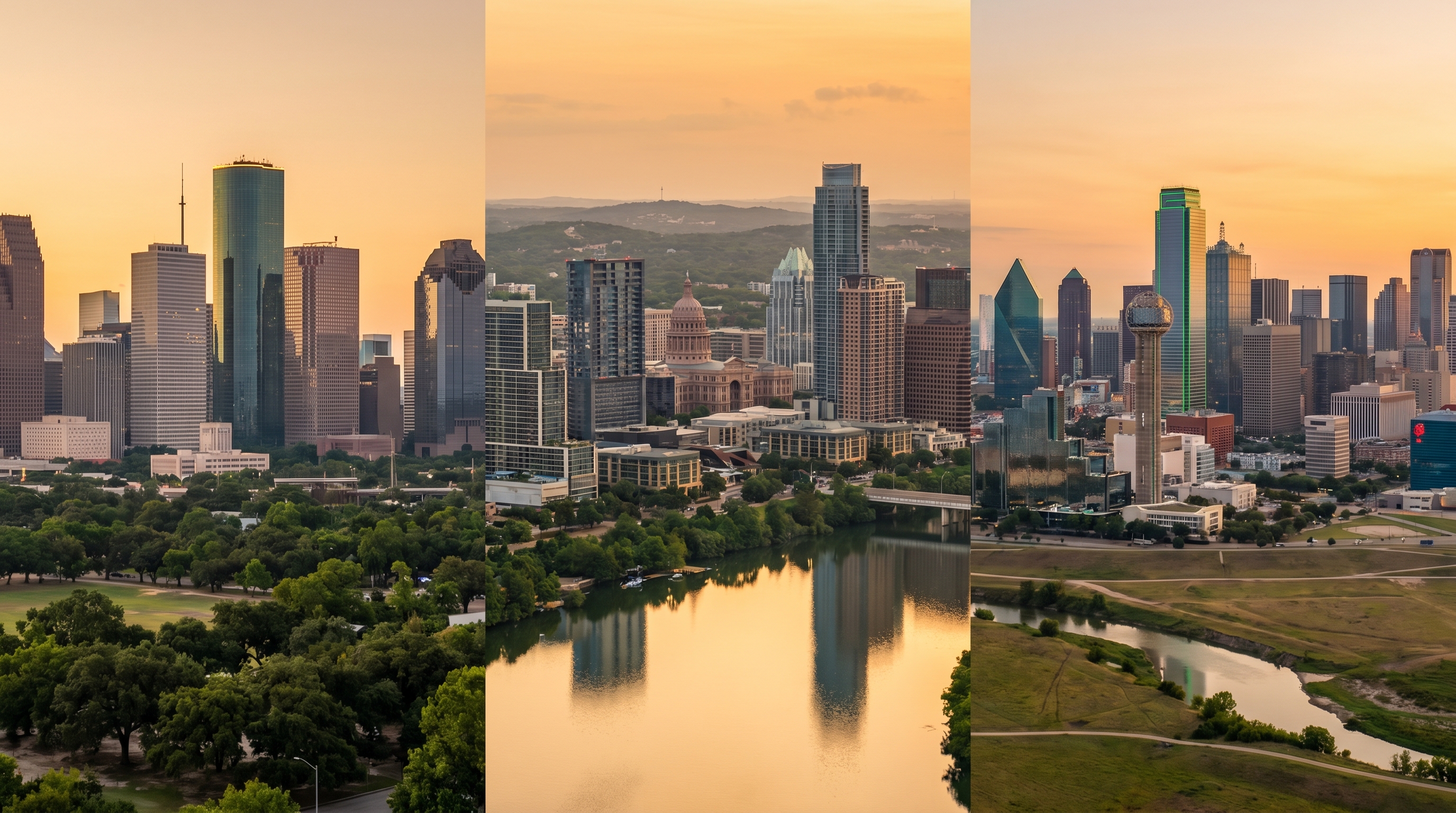
Houston vs Austin vs Dallas: Which Texas City Is Right for Your Family?
So you've already made the biggest decision: you're moving to Texas. No state income tax. A booming economy. Space to spread out. But now comes the question that keeps every relocating family up at night -- Houston, Austin, or Dallas?
Here's the deal. All three cities sit at the corners of what Texans call the Texas Triangle -- a megaregion of roughly 20 million people connected by Interstates 10, 35, and 45. All three share the advantage of no state income tax, relatively affordable housing compared to coastal metros, and strong job markets. But the similarities end there. The differences in housing costs, property taxes, school options, job sectors, climate, and daily lifestyle are significant enough to change your family's financial trajectory for the next decade.
Our team gets calls every week from families making exactly this decision. I live and work in Houston. I've helped dozens of families relocate here from California, New York, Illinois, and beyond. And I'm going to give you the honest comparison -- not a Houston sales pitch. If Austin or Dallas is better for your family, I'll tell you that. Let me walk you through the data.
The Master Comparison Table
| Category | Houston | Austin | Dallas-Fort Worth |
|---|---|---|---|
| Metro Population | 7.3 million (U.S. Census Bureau, 2024 estimate) | 2.4 million (U.S. Census Bureau, 2024 estimate) | 8.1 million (U.S. Census Bureau, 2024 estimate) |
| Median Listing Price | $359,897 (Realtor.com/FRED, April 2026) | $475,000 (Realtor.com/FRED, April 2026) | $430,000 (Realtor.com/FRED, April 2026) |
| Median Sale Price | $332,000 (HAR, April 2026) | $467,680 (Austin MLS, May 2026) | ~$390,000 (NTREIS, Q1 2026) |
| Property Tax Rate (Effective Avg) | 1.87% (Harris County, HCAD 2025) | 1.68% (Travis County, TCAD 2025) | 1.80% (Dallas County, DCAD 2025) |
| Annual Property Tax on Median Home | ~$6,210 | ~$7,855 | ~$7,020 |
| Cost of Living Index | 93.3 (BLS, national avg = 100) | 103.4 (BLS, national avg = 100) | 97.2 (BLS, national avg = 100) |
| Top Employment Sectors | Energy, healthcare, aerospace, shipping | Technology, government, higher education | Finance, telecom, defense, logistics |
| Average One-Way Commute | 29.3 minutes (Census ACS 2023) | 26.8 minutes (Census ACS 2023) | 28.5 minutes (Census ACS 2023) |
| Top-Rated School Districts | Katy ISD, Fort Bend ISD, Cy-Fair ISD | Eanes ISD, Round Rock ISD, Lake Travis ISD | Frisco ISD, Southlake Carroll ISD, Highland Park ISD |
| Climate | Subtropical, humid, mild winters | Subtropical, drier, Hill Country breezes | Continental, hot summers, occasional ice storms |
Deep Dive: Houston
Houston is the largest city in Texas by metro-area GDP and the fourth-largest city in the United States by population. The Houston-The Woodlands-Sugar Land metropolitan area recorded a median listing price of $359,897 in April 2026 according to Realtor.com data tracked by the Federal Reserve (FRED), making Houston the most affordable of the three Texas Triangle metros. HAR reported a median sale price of $332,000 for single-family homes in April 2026, with 32,681 active listings on the market according to Realtor.com inventory data.
And here's why that matters for your family specifically. Houston's property tax rates in Harris County average approximately 1.87% of assessed value according to HCAD records from 2025. But Houston property taxes vary significantly by location because of Municipal Utility Districts, commonly called MUDs. A homeowner in a MUD district may pay an additional 0.50% to 1.50% in MUD taxes on top of the county and school district rates. I tell every buyer the same thing: ask about MUDs before you make an offer. The Harris County homestead exemption removes $100,000 from the assessed value for county taxes, and the state of Texas provides an additional $100,000 homestead exemption for school district taxes, for a combined $200,000 reduction in taxable value effective January 2024 (Texas Tax Code Section 11.13).
Houston's economy is the most diversified of the three. The Texas Medical Center -- the largest medical complex in the world with over 106,000 employees -- the Port of Houston, NASA's Johnson Space Center, and the global headquarters of major energy companies including ConocoPhillips, Phillips 66, and Coterra Energy all call Houston home. The Houston metro area added approximately 83,400 jobs in 2024 according to the Texas Workforce Commission, with healthcare, construction, and professional services leading growth.
Houston's school landscape includes several TEA-rated "A" districts in the suburbs. Katy Independent School District, Fort Bend Independent School District, and Cypress-Fairbanks Independent School District consistently rank among the top large districts in Texas according to Texas Education Agency accountability ratings. I send most of my relocating families to Katy ISD or Fort Bend ISD for this reason.
Houston is best for: Families seeking the lowest housing costs among the three metros, professionals in energy, healthcare, or aerospace, and buyers who value ethnic and culinary diversity. Houston is home to over 145 languages spoken across the metro area, making it the most ethnically diverse large city in the United States according to the Kinder Institute for Urban Research at Rice University. And here's what's super fun about that -- when I take clients out to dinner in Houston, we can eat Ethiopian, Vietnamese, Nigerian, Colombian, Indian, all within a 15-minute drive.
The honest downside: Houston is flat, humid, and prone to flooding. I'm not going to sugarcoat that. June through September, you're going to sweat. Hurricane season runs June through November. Traffic congestion on the I-610 Loop and I-45 corridors is significant. And the lack of zoning means a commercial property can sit next to a residential street, which creates both opportunity and unpredictability in neighborhoods. I help every one of my clients check FEMA flood maps before they buy.
Deep Dive: Austin
Austin is the capital of Texas and the cultural heart of the state. The Austin-Round Rock metropolitan area recorded a median listing price of $475,000 in April 2026 according to Realtor.com data tracked by the Federal Reserve (FRED), making Austin the most expensive of the three Texas Triangle metros. The Austin Board of REALTORS reported a median sold price of $467,680 in May 2026. Austin home prices peaked in 2022 and have since corrected, with the city experiencing the fourth-largest decrease in home values among major U.S. metros since 2022 according to a 2026 SmartAsset analysis.
Austin's property tax rates in Travis County average approximately 1.68% of assessed value according to Travis Central Appraisal District (TCAD) records from 2025. While Austin's rate is the lowest of the three cities, the higher home values mean the actual dollar amount of annual property taxes in Austin typically exceeds Houston and rivals Dallas. On a $475,000 median-priced Austin home, a homeowner would pay approximately $7,855 annually in property taxes after applying the state homestead exemption.
Austin's economy has transformed into a major technology hub. Tesla relocated its headquarters to Austin in 2021. Apple opened a $1 billion campus in North Austin. Samsung, Oracle, Google, Meta, and Amazon all maintain significant Austin operations. The University of Texas at Austin, the state's flagship university with over 51,000 students, and state government employment provide an economic base that supplements the tech sector.
Austin's top school districts include Eanes Independent School District (home to Westlake High School), Round Rock Independent School District, and Lake Travis Independent School District, all of which hold TEA "A" ratings. Eanes ISD consistently ranks among the top 10 school districts in Texas by academic performance.
Austin is best for: Technology professionals and remote workers, young families who prioritize outdoor lifestyle and cultural access, and buyers who value a smaller-city feel with big-city amenities. The Hill Country terrain west of Austin offers hiking, swimming holes, and natural beauty that neither Houston nor Dallas can match.
The honest downside: Austin is expensive relative to its Texas peers. The median listing price of $475,000 is 32% higher than Houston's $359,897. Austin traffic has worsened dramatically as the metro population grew from 1.7 million in 2010 to 2.4 million in 2024. Water supply is a growing concern, with the Colorado River basin facing drought pressures. And the tech sector's volatility -- including significant layoffs in 2022-2023 -- introduced economic uncertainty that Houston's diversified economy doesn't share.
Deep Dive: Dallas-Fort Worth
The Dallas-Fort Worth-Arlington metropolitan area is the largest metro in Texas by population at approximately 8.1 million residents according to 2024 Census estimates. The DFW metro recorded a median listing price of $430,000 in April 2026 according to Realtor.com data tracked by the Federal Reserve (FRED), positioning Dallas between Houston and Austin in affordability.
Dallas property tax rates in Dallas County average approximately 1.80% of assessed value according to Dallas Central Appraisal District (DCAD) records from 2025. Property tax rates in the DFW suburbs vary widely -- Collin County (Frisco, Plano, McKinney) and Denton County (Flower Mound, Southlake) often carry slightly lower effective rates than Dallas County proper due to different school district and municipal tax structures.
The DFW economy is defined by corporate headquarters density. Twenty-two Fortune 500 companies are headquartered in the DFW metro according to the Fortune 500 list (2025), including AT&T, ExxonMobil (which relocated from Houston in 2023), McKesson, Tenet Healthcare, and CBRE Group. Dallas-Fort Worth International Airport (DFW), the second-busiest airport in the United States by passenger traffic, serves as a hub for American Airlines and provides the metro with unmatched domestic and international connectivity.
The DFW suburbs contain some of the highest-performing school districts in Texas. Frisco Independent School District, Southlake Carroll Independent School District, and Highland Park Independent School District all carry TEA "A" ratings with nationally recognized academic and extracurricular programs. Frisco ISD, serving over 70,000 students, has been one of the fastest-growing districts in the nation.
Dallas-Fort Worth is best for: Corporate professionals and frequent business travelers (DFW Airport is a real advantage), families seeking top-tier suburban school districts, and buyers who prefer a balance between urban amenities and suburban space. The northern suburbs -- Frisco, Prosper, Celina -- offer significant new-construction inventory for growing families.
The honest downside: DFW weather includes ice storms and occasional tornadoes. North Texas sits in Tornado Alley, and severe weather from March through June is a reality. The metro area sprawls extensively, and living in a northern suburb like Frisco while working in downtown Dallas can mean a 45-minute to one-hour commute each way. Dallas lacks the coastal energy culture of Houston and the outdoor lifestyle of Austin.
The Property Tax Reality: No State Income Tax, But...
So here's the conversation I have with every relocator. All three Texas cities benefit from zero state income tax, which saves most families thousands of dollars annually compared to states like California (top rate 13.3%), New York (top rate 10.9%), or Illinois (flat rate 4.95%). But Texas compensates with property taxes that rank among the highest in the nation.
| Tax Comparison | Houston | Austin | Dallas |
|---|---|---|---|
| State Income Tax | 0% | 0% | 0% |
| Effective Property Tax Rate | ~1.87% | ~1.68% | ~1.80% |
| Tax on $400K Home (after exemptions) | ~$3,740 | ~$3,360 | ~$3,600 |
| Tax on $600K Home (after exemptions) | ~$7,480 | ~$6,720 | ~$7,200 |
| Sales Tax Rate | 8.25% | 8.25% | 8.25% |
Note: Property tax calculations apply the $100,000 state homestead exemption for school district taxes. Actual rates vary by specific school district, city, and special district. Source: Texas Comptroller of Public Accounts, county appraisal district records (2025).
Which City Is Right for You? A Decision Framework
So here's how I break it down for my clients.
Choose Houston if you:
- Want the most affordable housing among the three metros
- Work in energy, healthcare, aerospace, or international trade
- Value ethnic and culinary diversity
- Are comfortable with humidity and flood-zone awareness
- Want the widest range of housing options from $250K starter homes to $20M estates
Choose Austin if you:
- Work in technology or can work remotely
- Prioritize outdoor recreation and natural beauty
- Prefer a smaller metro with a distinct cultural identity
- Can absorb the higher housing costs (32% above Houston)
- Are drawn to a younger, university-influenced community
Choose Dallas-Fort Worth if you:
- Work in corporate management, finance, or defense
- Travel frequently for business (DFW Airport advantage)
- Prioritize top-tier suburban school districts
- Prefer a moderate climate without Houston's humidity
- Want access to a large new-construction suburban market
Frequently Asked Questions
Which Texas city has the lowest cost of living?
Houston has the lowest cost of living among the three major Texas metros. Houston's cost of living index is 93.3 compared to the national average of 100, according to Bureau of Labor Statistics data. Dallas-Fort Worth scores 97.2, and Austin scores 103.4. Houston's lower housing costs are the primary driver of this difference, with a median listing price of $359,897 compared to Austin's $475,000 and Dallas's $430,000 as of April 2026 (Realtor.com/FRED).
Is Austin more expensive than Houston?
Austin is significantly more expensive than Houston for housing. The Austin metro median listing price of $475,000 is approximately 32% higher than Houston's $359,897 as of April 2026 (Realtor.com/FRED). However, Austin's effective property tax rate of 1.68% is lower than Houston's 1.87%, partially offsetting the higher purchase price. Overall cost of living in Austin is approximately 11% higher than Houston according to BLS cost of living index data.
Which Texas city has the best schools?
All three Texas metros contain TEA "A"-rated school districts, so the answer depends on which suburb you choose rather than which city you choose. Houston's top districts include Katy ISD and Fort Bend ISD. Austin's top districts include Eanes ISD and Round Rock ISD. Dallas-Fort Worth's top districts include Frisco ISD and Southlake Carroll ISD. Each of these districts holds an "A" rating from the Texas Education Agency and ranks among the top districts statewide.
Do you pay state income tax in Texas?
Texas does not levy a state income tax on individuals. This applies equally to residents of Houston, Austin, and Dallas. Texas is one of nine U.S. states with no state income tax. However, Texas property tax rates are among the highest in the nation, averaging 1.60% to 1.90% depending on location, which partially offsets the income tax savings. Source: Texas Comptroller of Public Accounts.
Which Texas city is growing the fastest?
The Dallas-Fort Worth metro is the largest and has added the most residents in absolute numbers, gaining approximately 170,000 new residents between 2022 and 2024 according to U.S. Census Bureau estimates. Austin has the fastest percentage growth rate among the three, though its growth has slowed from the explosive pace of 2020-2022. Houston continues steady growth driven by international immigration and domestic relocation from higher-cost states.
Key Takeaways
- Houston is the most affordable of the three Texas metros ($360K median listing) with the most diversified economy and the highest ethnic and culinary diversity in the state.
- Austin costs 32% more than Houston for housing but offers the Hill Country lifestyle, the tech job market, and the lowest effective property tax rate of the three.
- All three cities share the same advantage -- no state income tax -- but the right choice depends on where you work, what you can afford, and what kind of daily life matters most to your family.
Questions to Ask Yourself
- Where do you work, and which city puts you closest to your industry's center of gravity?
- Have you run the full cost-of-ownership comparison -- not just home price, but property taxes, MUDs, insurance, and commute costs?
- Have you visited all three cities during a regular week (not vacation) to feel the daily rhythm?
What We Can Do
If you're considering a move to Houston, we specialize in helping families relocate from out of state. We know the suburbs, the school districts, and the property tax landscape from the inside -- not from a web search. Give us a call, shoot us a text, or send us an email.
Schedule a Houston relocation consultation: [PHONE NUMBER] | [WEBSITE URL]
We're here to help with your real estate introductions and connections here in the Houston area and across the nation.
Article Schema (JSON-LD)
```json
```
Ready to Take the Next Step?
Our team specializes in Houston real estate.
Contact The Property Joes Group